89% of businesses now use video marketing and 93% of organizations say video conversion rates match or beat every other content format they run. So the question isn’t whether you should produce video. It’s whether your production setup can actually keep up with how much video content you need to get ahead of your competition.
Over 55% of marketers produce videos in-house, yet bandwidth complaints are universal. As a result, over 31% of businesses produce videos in-house while also working with vendors to scale video production.
It’s clear that in-house teams alone can’t keep up with the volume of modern marketing demands.
Hiring more people feels like the obvious fix, but it’s slow, expensive, and still leaves you capped by headcount. In this blog, we take a look at how to scale video content by building a production system that grows with demand instead of with your payroll.
Key takeaways
- 89% of businesses use video marketing, but most in-house teams can’t keep up with the volume modern channels demand.
- Hiring in-house video producers is slow, expensive, and creates management overhead that compounds over time.
- A video production subscription like SoCreative lets you skip the hiring process entirely. You just submit a brief and receive edited videos in 24-48 hours.
- Scaling sustainably means standardizing your workflow first, then plugging execution into a system built for continuous output.
Why scaling video content becomes a bottleneck
Five years ago, you might have needed one promo video per quarter. Today, most brands need dozens of videos per month including short-form ads, product walkthroughs, social cutdowns, testimonial clips, and explainer videos for different audiences.
Here are some of the reasons why scaling video content has now become a bottleneck
Production models weren’t built for this: The real issue is not the in-house team but the fact that traditional production workflows, whether run by creative agencies, freelancers, or your own in-house team were designed for project-based output. They weren’t built for the continuous content pipeline that modern digital marketing now demands.
More channels mean more formats: You’re no longer producing one video and distributing the same copy everywhere. Each platform has its own specs, aspect ratios, and audience expectations. A single campaign can require five or six different edits before it even goes live. Without a system that handles that volume, your team spends more time reformatting than creating.
In-house vs design subscription model: What actually scales?
Here are the key differences between in-house teams and managing video production without an in-house team through a design subscription like SoCreative.
| Factor | In-house team | Design subscription |
| Speed | Slow ramp-up. Hiring and onboarding can take weeks before output starts | 24-48 hour turnaround on edits. Production starts the day you submit a brief |
| Cost structure | Fixed salaries, benefits, equipment, and software licenses required, regardless of output volume | Credit-based model with predictable quarterly pricing. You pay for output, not overhead |
| Scalability | Limited by headcount. More output requires more hires. | Scales with demand. You can add requests without adding people. |
| Skill coverage | Limited to whoever you hired. Any skill gaps require another round of recruiting. | Access to a global network of vetted videographers, editors, and motion designers. |
| Management | Requires daily oversight, project management, and creative direction. | Managed within one centralized platform. Briefs, feedback, and delivery in one place. |
| Output volume | Bottlenecked by team bandwidth and competing priorities. | Continuous content pipeline. Submit requests as fast as your strategy demands. |
.
How to scale video production with SoCreative
Scaling video requires a repeatable system that handles volume without breaking. Here’s the process teams use to build a real video content scaling strategy with SoCreative, a subscription-based video production service.
Step 1: Build your video content strategy
Define your core video content types, such as ads, social, product, lifecycle and map them to the relevant funnel stages. Identify the platforms and formats each asset needs to serve and also look at brand video examples in your space to see what’s working and what just isn’t. Remember, every video should have a clear purpose before it enters production.
Step 2: Standardize before you scale
Lock down your brand guidelines, editing styles, file naming conventions, and approval workflows before you even start video production at scale. Standardization helps reduce back-and-forth and makes it possible to plug external execution into your system without losing consistency.
Step 3: Move execution to a scalable system
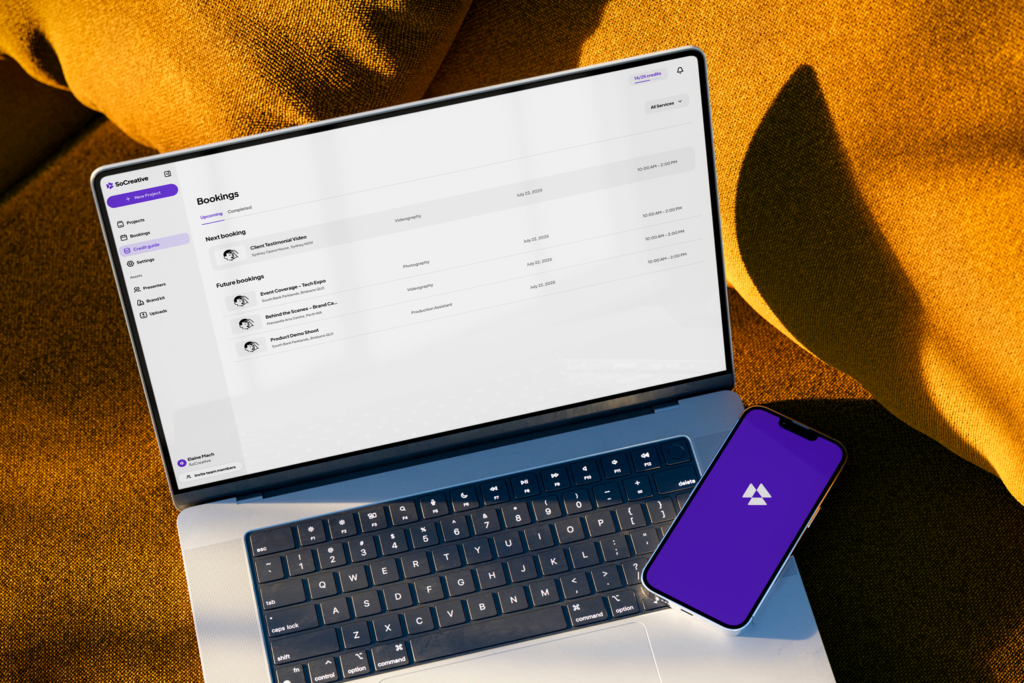
Instead of expanding headcount, shift production into a system designed for volume. With SoCreative, which functions as your video marketing agency, video editing company, and production team rolled into one, the workflow is super simple:
- Get a quarterly design subscription at a fixed price
- Submit your brief
- Our team starts working on it immediately with no hiring delays or onboarding cycles
- Get edited videos delivered in 24-48 hours
- Manage feedback and revisions inside one centralized platform
- Repeat the entire process at scale
Step 4: Batch and repurpose to multiply output
Film multiple videos in one shoot instead of producing them one at a time. Take that footage and turn it into short-form clips, ad variations, and platform-specific edits. So a webinar can turn into clips, ads, and social snippets and a customer interview can become testimonials and short edits.
Whether you need B2B video production cutdowns or consumer-facing social content, you can submit these as batch requests through SoCreative to extend the lifecycle of every asset without overloading your team.
Step 5: Track performance and feed insights back into production
Measure watch time, engagement rates, and conversion metrics by format and platform. Use those insights to request new variations, adjust messaging, and improve future content.
Because production cycles are fast, measured in hours, not weeks, you can implement updates quickly without restarting the process.
Step 7: Build a continuous production loop
At scale, video production becomes an ongoing system. The loop includes planning, producing, analyzing, iterating, and repeating.
With SoCreative handling execution, you submit new requests continuously, keep your content pipeline active, and scale output without additional hiring.
SoCreative helps you scale video production in just a few clicks
You don’t need a bigger team to produce more videos. All you need is a better system and a reliable provider.
SoCreative gives you a repeatable system for continuous video production with vetted videographers, in-house video editors, and a centralized platform for briefs and feedback.
Book a demo to see how it works, or walk through the platform with us to see how SoCreative fits into your current workflow.
FAQs
How is a video production subscription different from hiring a freelancer or agency?
Freelancers require sourcing and onboarding for every project. Agencies are great for big campaigns but slow to scale and expensive to re-scope. A subscription gives you a dedicated production system where you submit briefs, get matched with vetted videographers and editors, and receive finished videos in 24-48 hours. No vendor sourcing, no renegotiating scope every time your needs change.
What types of videos can SoCreative produce?
Pretty much anything your marketing team needs on a regular basis. That includes social media ads, product walkthroughs, explainer videos, testimonial edits, event recaps, short-form cutdowns, and platform-specific variations. If it fits into a brief, it fits into the system.
Written by

Ritika Tiwari
Ritika Tiwari is a content strategist and writer with over 10 years of experience creating content for SaaS B2B brands. Outside of work, you’ll likely find her somewhere near the ocean.